If you want to start investing in the stock market, the first skill you must learn is how to read a stock quote.
A stock quote is a compact snapshot of a stock’s current status: price, volume, valuation (market cap), PE ratio, and much more.
Introduction to Read a Stock Quote
Beginners often feel overwhelmed by numbers and abbreviations on trading apps — this guide removes the confusion with easy explanations,
realistic examples and practical tips so you can make smarter investment decisions.
Quick story: Arjun, a college student, once bought a stock only to see it drop 12% the next day. After learning how to read stock quotes properly, he began checking PE ratio, volume and market cap before buying—and avoided unnecessary losses.
Quick Overview / Summary
| Stock Quote Element | Meaning | Why It Matters |
|---|---|---|
| Current Price | Latest traded price | Shows entry/exit level |
| Volume | Shares traded today | Indicates demand |
| Market Cap | Total company valuation | Shows company size (Large/Mid/Small) |
| PE Ratio | Price ÷ Earnings | Valuation meter |
| 52-Week High/Low | Highest/lowest in last 12 months | Shows volatility range |
Tip: Use this table as a checklist before buying any stock.
Key Elements of a Stock Quote (Explained)
1. Current Market Price (CMP)
Definition: The latest price at which the stock is trading. Example: TCS CMP = ₹3,820. This is the price you will buy or sell at right now.
2. Previous Close & Open Price
Previous Close: Yesterday’s closing price — useful for daily percent change calculations.
Open Price: Price at the start of the trading day — shows early sentiment.
3. Day High / Day Low
These values show intraday volatility and the price range within which the stock has moved today.
4. 52-Week High & 52-Week Low
These are the extreme values over the last 12 months. Stocks near 52-week highs may be priced for perfection; stocks near 52-week lows may be undervalued—or risky.
5. Volume
Volume tells how many shares were traded today. Watch for sudden volume spikes—they often accompany important news or institutional buying/selling.
6. Market Capitalization (Market Cap)
Market Cap = Share Price × Total Outstanding Shares. Categories: Large-cap (stable), Mid-cap (growth potential), Small-cap (higher risk, higher return).
7. PE Ratio
PE = Price ÷ Earnings per Share (EPS). Use industry averages to judge whether a PE is high or low. A high PE could mean high growth expectations, not necessarily overvaluation.
8. Dividend Yield
Dividend Yield = (Annual Dividend ÷ Current Price) × 100. A useful metric for income-focused investors.
9. Bid / Ask & Spread
Bid: highest price a buyer will pay. Ask: lowest price a seller will accept. The spread (difference) indicates liquidity—narrow spread = liquid stock.
Sample Quote (Example)
| Parameter | Value |
|---|---|
| Current Price | ₹1,250 |
| Open | ₹1,240 |
| Day High / Low | ₹1,275 / ₹1,230 |
| 52-Week High / Low | ₹1,350 / ₹780 |
| Volume | 2.1M |
| Market Cap | ₹65,000 Cr |
| PE Ratio | 22.4 |
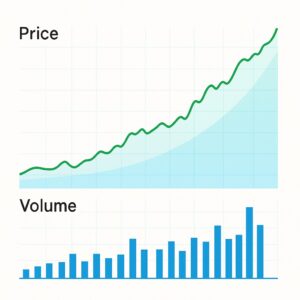
Visual: Quick Chart (Price vs Volume)
This is a placeholder illustration showing how price (line) and volume (bars) often appear together. Use real charting tools (TradingView, Zerodha Kite) for live data.
Practical Checklist: Before Buying a Stock
- Check the 52-week range—is the stock near high/low?
- Compare the PE ratio with peers in the industry.
- Look for volume spikes—they indicate strong interest or news.
- Note the market cap to choose the right risk profile (Large/Mid/Small).
- Read the latest company news—earnings, management changes, orders.
Pro tip: Spend 5 minutes on the stock quote checklist before placing any order.
Realistic Story: Arjun’s Learning Curve
Arjun bought a small-cap stock after watching a quick video. He ignored the PE ratio and volume. The reaction was brutal: the stock fell 12% the next day.
He joined a small study group, learned how to read quotes, and started checking basic metrics for the next picks. Within a few months his win-rate improved and so did his confidence.
Lessons: numbers tell a story. The quote is the most immediate story of that day.
Frequently Asked Questions (20)
1. What is a stock quote?
A stock quote gives real-time information about a stock’s price, volume and other metrics (market cap, PE, 52-week range). It is the basic snapshot traders and investors use to decide action.
2. Where can I read stock quotes?
On financial websites and apps such as NSE, BSE, Moneycontrol, Zerodha (Kite), Groww, Upstox and Google Finance.
3. What is the PE ratio and how should I use it?
PE = Price divided by Earnings per Share (EPS). Use it to compare valuations within the same industry. A higher PE usually signals higher growth expectations.
4. Does high volume always mean a good buy?
Not always. High volume indicates interest—but whether it’s good depends on context: news, direction, and price action. Check if price moves up on high volume (bullish) or down on high volume (bearish).
5. What is market cap and why does it matter?
Market cap is total company valuation = share price × outstanding shares. It helps classify companies into large/mid/small cap and determine risk profile.
6. Where do I start as a beginner?
Start with the basics: CMP, volume, 52-week range and PE ratio. Use demo accounts and read company summaries. Join learning groups for curated notes and daily tips.
More FAQs (short answers)
- What is previous close? — Yesterday’s last traded price.
- What is open price? — First traded price of the day.
- What is dividend yield? — Annual dividend divided by price (in %).
- What is bid/ask? — Buyer price / seller price.
- What is spread? — Difference between bid & ask.
- Is PE universal? — No, compare within the same industry.
- How to use 52-week range? — Check for breakout or support levels.
- Are low PE stocks always good? — Not necessarily; check fundamentals.
- Can volume predict price movement? — It helps when combined with price direction.
- Best app for beginners? — Moneycontrol / Zerodha / Groww for quotes and learning.
Conclusion — Read Quotes, Not Noise
A stock quote is your first window to the market. Learning to read the CMP, volume, market cap, PE ratio and related metrics will turn confusion into clarity.
Use the practical checklist in this guide and spend a few minutes on every trade — it pays off in the long run.
Free PDF: Quick Stock Quote Checklist
How to Read a Stock Quote