How Does the Stock Market Work? Explained with Real-Life Examples
Introduction:
The stock market often sounds complex and intimidating to beginners — a place where numbers change every second, traders shout orders, and fortunes rise and fall. But beneath the surface, the stock market is simply a platform where people buy and sell ownership of companies. Whether you’re an investor planning for the long term or a trader looking for quick profits, understanding how the stock market works is essential.
In this guide, we’ll explain how the stock market works in India, step-by-step, with real-life examples that make complex concepts easy to grasp. You’ll learn about stock exchanges, how shares are bought and sold, who the key players are, and how you can start investing with confidence.
📘 Quick Overview
| Topic | Details |
|---|---|
| Article Title | How Does the Stock Market Work? Explained with Real-Life Examples |
| Focus Keyword | How Does the Stock Market Work? Explained with Real-Life Examples |
| Category | Stock Market Learning Guide |
| Reading Time | 10 Minutes |
| Published On | November 2025 |
| Written For | Beginners, Students, New Investors |
🔗 Important Links
| Resource | Link |
|---|---|
| Official Website | https://finbankingtech.com |
| Join Telegram Channel | t.me/finbankingtech |
| Join WhatsApp Group | Join WhatsApp |
🧾 Summary Table
| Aspect | Summary |
|---|---|
| What is the Stock Market? | A platform for buying and selling ownership shares of companies. |
| How It Works | Investors trade shares via exchanges like NSE and BSE through brokers. |
| Main Players | Investors, Brokers, Companies, SEBI, and Stock Exchanges. |
| Goal | To raise capital for businesses and offer returns for investors. |
| Example | When you buy a share of Infosys, you own a small part of that company. |
📊 What is the Stock Market?
The stock market is a marketplace where shares (ownership parts of companies) are bought and sold. When a company needs funds to grow, it offers its shares to the public through an IPO (Initial Public Offering). Once listed, these shares are traded daily on stock exchanges like NSE (National Stock Exchange) and BSE (Bombay Stock Exchange).
What is the Stock Market? Complete Beginner’s Guide (India)
🔍 Real-Life Example
Imagine you buy 10 shares of Infosys at ₹1,500 each. If the price rises to ₹1,700, you make ₹200 per share as profit. Conversely, if the price drops to ₹1,400, you face a loss of ₹100 per share. This price movement reflects investor sentiment, company performance, and market demand.
⚙️ How Does the Stock Market Work in India?
Here’s how the Indian stock market works step-by-step:
- Company Listing: A company lists its shares on NSE/BSE via an IPO.
- Trading Begins: Once listed, shares can be freely traded by anyone through their broker.
- Stock Price Movement: Prices rise or fall based on supply, demand, company results, and market news.
- Settlement: Trades are settled (money and shares exchanged) in T+1 day in India.
- SEBI Oversight: The Securities and Exchange Board of India (SEBI) ensures transparency and fairness.
👥 Key Players in the Stock Market
- Investors: People who buy shares to earn returns.
- Brokers: Registered intermediaries who execute trades (e.g., Zerodha, Groww).
- Companies: Issue shares to raise funds for business growth.
- Stock Exchanges: NSE and BSE provide the trading platform.
- SEBI: Regulates and monitors the entire system.
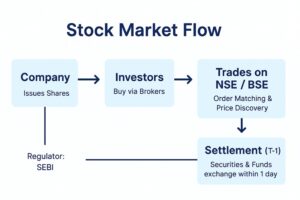
📉 Stock Market Flow (Visual Chart)
Company → Issues Shares → Investors Buy via Brokers → Trades on NSE/BSE → Settlement (T+1)
Stock Market Flow — Simple Overview
Company issues shares → Investors buy through brokers → Trades executed on NSE/BSE → Settlement (T+1)
💱 Types of Stock Market Transactions
| Type | Description |
|---|---|
| Delivery Trading | You buy shares and hold them for days or years. |
| Intraday Trading | Buy and sell shares within the same day. |
| Futures & Options | Contracts based on future price predictions. |
| Mutual Funds | Professionally managed investment in a basket of stocks. |
✅ Eligibility Criteria
- Must be 18 years or older.
- Valid PAN and Aadhaar Card.
- Active Bank Account and Demat Account.
- KYC Verification Completed.
- Registered with SEBI-authorized Broker.
How Does the Stock Market Work
📚 Real-Life Example: Reliance Industries
When Reliance Industries listed its shares in the Indian stock market decades ago, early investors saw their investment grow multifold. A ₹10,000 investment in the 1980s is worth lakhs today — proving the power of patience and compounding in the stock market.
💡 Tips for Beginners
- Start with small investments.
- Focus on long-term goals, not quick profits.
- Research before investing — use company reports and news.
- Don’t follow market rumours or tips blindly.
- Diversify your portfolio to reduce risks.
❓ Frequently Asked Questions (FAQs)
- Q: What is the stock market in simple terms?
A: It’s a platform where investors buy and sell ownership shares of companies. - Q: Who regulates the Indian stock market?
A: The SEBI (Securities and Exchange Board of India). - Q: What are NSE and BSE?
A: India’s two main stock exchanges — National Stock Exchange and Bombay Stock Exchange. - Q: What is an IPO?
A: When a company offers its shares to the public for the first time. - Q: Can anyone buy shares in India?
A: Yes, anyone above 18 with PAN, Aadhaar, and a Demat account. - Q: How do I earn profit from stocks?
A: Through capital gains (price rise) or dividends (company profit sharing). - Q: What is a Demat Account?
A: It stores your shares in electronic form. - Q: What is a Trading Account?
A: It’s used to buy/sell shares in the market. - Q: What is the difference between investing and trading?
A: Investing is long-term; trading is short-term. - Q: What is T+1 settlement?
A: Trades are settled within one business day after the transaction date. - Q: Is the stock market risky?
A: Yes, but risks can be reduced through research and diversification. - Q: Can I start with ₹100?
A: Yes, some platforms allow fractional or small investments. - Q: How is stock price decided?
A: By demand and supply in the market. - Q: What are blue-chip stocks?
A: Shares of large, stable, and reputed companies. - Q: Can I invest in foreign stocks from India?
A: Yes, via international mutual funds or global investment apps. - Q: How do I avoid losses?
A: Use stop-loss orders and invest wisely. - Q: What is SEBI’s role?
A: To regulate, monitor, and protect investors in the securities market. - Q: What is a portfolio?
A: A collection of all your investments (stocks, mutual funds, etc.). - Q: Can I invest in IPOs through UPI?
A: Yes, most brokers allow IPO applications via UPI ID. - Q: Where can I learn stock market basics?
A: Follow our website FinBankingTech.com for free learning guides.
🏁 Conclusion
Now you know how the stock market works in India — from company listings to trading and settlements. With real-life examples, it’s clear that stock investing is not gambling, but a disciplined wealth-building process. Start small, stay consistent, and remember — knowledge is your greatest investment tool.
📢 Join Our Telegram for Stock Updates
Visit Official Website: FinBankingTech.com
📖 Real-Life Story:
How Ramesh Discovered How the Stock Market Really Works
Meet Ramesh Sharma, a 29-year-old IT engineer from Pune. Like many Indians, he had always heard people talk about the “share market” — sometimes with excitement, sometimes with fear. Every evening, when his father watched the news and saw the Nifty and Sensex numbers go up and down, Ramesh wondered, “What do these numbers actually mean?”
One day, during the pandemic in 2020, Ramesh decided to explore it seriously. He opened a Demat and Trading account on a popular app (Zerodha), added ₹5,000 from his savings, and bought two shares of Tata Motors at ₹100 each. He didn’t know much, but he wanted to learn by doing.
In the following weeks, Ramesh watched the stock price move every day — sometimes up, sometimes down. He realized that these movements reflected how people felt about the company’s performance, profits, and future. A month later, Tata Motors’ quarterly results showed improvement, and the stock jumped to ₹120. That’s when he understood how the stock market really works — it’s not luck, it’s confidence, demand, and performance.
Excited, Ramesh didn’t sell immediately. He researched and learned that when more people want to buy a stock, its price rises — and when they sell, it falls. He read about how SEBI regulates markets, how companies raise money through IPOs, and how the stock exchanges (NSE, BSE) act as the marketplace for trading.
Six months later, his small investment of ₹5,000 had grown to ₹6,500. That ₹1,500 profit was more than just money — it was proof that knowledge pays off. Ramesh started learning about mutual funds, SIPs, and blue-chip stocks, slowly building a diversified portfolio.
Today, Ramesh isn’t a full-time trader. He still works his 9-to-5 job, but every month he invests a portion of his salary in the stock market. He knows that the market rewards patience and research, not emotion. His story is a reminder that anyone — even without a finance background — can understand how the stock market works in India and use it to achieve long-term financial freedom.
💬 Moral of the Story
The stock market isn’t gambling — it’s a reflection of business and human psychology. It rewards those who learn, stay disciplined, and think long-term. Just like Ramesh, you don’t need to be an expert — you just need curiosity, consistency, and confidence.
🧑💻 Real-Life Story 2:
The Young Trader Who Learned Patience – Aarav’s Journey
Aarav Mehta was a 23-year-old commerce graduate from Delhi who always dreamed of earning money online. He started trading in the stock market right after college, inspired by social media traders flaunting profits. With ₹10,000 in his account, Aarav began intraday trading — buying and selling stocks in a single day.
In his first week, he made ₹800 profit trading HDFC Bank. He was thrilled! But the next week, he lost ₹1,200 trying to predict the market without any strategy. That’s when he realized the stock market wasn’t a shortcut to wealth — it was a test of discipline.
Aarav started reading about technical analysis, candlestick patterns, and moving averages. He learned that trading isn’t about guessing — it’s about managing risk. He used stop-loss orders and limited his losses to 2% per trade.
Over the next six months, his trading improved. Instead of chasing profits, he focused on consistency. Aarav learned that the stock market works like any business — profits come when you respect the process and control your emotions.
Today, Aarav shares his trading journey on social media, inspiring others to learn the basics before they trade. His story teaches us that knowledge + discipline = success, even in a market full of uncertainty.
💬 Lesson from Aarav’s Story
Don’t try to beat the market — understand it. The stock market rewards consistency, not greed.
👴 Real-Life Story 3:
The Retired Investor Who Found Financial Freedom – Mr. Iyer’s Lesson
Mr. S. Iyer, a retired teacher from Chennai, used to believe that the stock market was risky and meant only for the rich. For most of his life, he kept his savings in fixed deposits and recurring accounts, earning around 5–6% interest.
One day, his son explained how companies like Infosys, HDFC, and Reliance had grown over the years, creating wealth for long-term investors. Curious, Mr. Iyer attended a few investor awareness webinars organized by SEBI and started learning about dividends, compounding, and blue-chip stocks.
At age 61, he invested ₹1 lakh across 5 large-cap companies and continued to reinvest the dividends he received. Over the next 10 years, his investment grew more than 3x, providing him an extra source of income during retirement.
He now tells his friends, “If I had understood how the stock market works earlier, I would have started investing in my 30s.” Today, Mr. Iyer enjoys his retirement peacefully, supported by his steady dividend income — a reward for believing in India’s growth story.
💬 Lesson from Mr. Iyer’s Story
It’s never too late to start investing. The stock market works best for those who stay invested, not those who try to time it.