Check Adani Enterprises share price, latest results, financial performance, business segments, valuation factors, risks and future outlook.
Market-data verification note: The information supplied in your brief quotes ₹2,624.90 as the share price on October 9, 2026. However, the accessible historical market data I found reports a closing price of ₹2,596 on October 8, 2026, after a decline of 5.36%. I could not independently verify the supplied October 9 intraday quote, volume, market capitalisation or P/E ratio. The article therefore uses ₹2,596 only as the reported October 8 close and does not present the unverified figures as confirmed live data.
Adani Enterprises Share Price, Financial Results & Future Outlook
Adani Enterprises Limited (NSE: ADANIENT, BSE: 512599) is the flagship business incubator of the Adani Group. Unlike a company focused on just one industry, it operates across several businesses and develops new infrastructure and industrial ventures, including airports, roads, renewable-energy manufacturing, copper and data centres.
This diversified business model makes the Adani Enterprises share price particularly interesting to investors researching India’s infrastructure and energy-transition themes. However, evaluating the stock requires more than looking at its latest price movement. Investors also need to understand its operating performance, capital expenditure, debt and funding requirements, business execution, valuation and the risks associated with emerging businesses.
The stock can experience sharp price movements. A decline over a single trading session does not automatically mean the business has deteriorated, just as a sharp rise does not necessarily mean the stock has become attractive. Market prices reflect expectations about future earnings, risk, liquidity and broader economic conditions.
This article examines the available market information as of October 9, 2026, Adani Enterprises’ latest reported financial results, its business model, factors that could influence future performance and the key risks investors should investigate before making a decision.
Quick Overview of Adani Enterprises
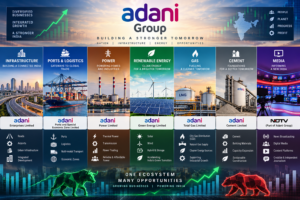
| Particular | Details |
|---|---|
| Company name | Adani Enterprises Limited |
| NSE symbol | ADANIENT |
| BSE scrip code | 512599 |
| Sector | Diversified infrastructure, industrial and incubation businesses |
| Reported close on October 8, 2026 | ₹2,596.00 |
| Previous trading-session close, October 7 | ₹2,743.00 |
| October 8 price change | −₹147, or approximately −5.36% |
| Latest results covered | Q1 FY2026–27 |
| Financial year | April to March |
| Official stock information | NSE India |
| Official company information | Adani Enterprises |
The price figures above are historical market data, not a live quote. Check the exchange for the latest trading price before relying on any market snapshot.
Key Takeaways
-
Adani Enterprises develops and operates businesses across infrastructure, airports, roads, renewable-energy manufacturing, copper and data centres.
-
For FY2025–26, the company reported consolidated total income of ₹1,02,943 crore and EBITDA of ₹16,464 crore.
-
Its Q1 FY2026–27 results showed total income of ₹33,546 crore, up 50% year on year, but profit after tax attributable to owners was negative ₹1,160 crore after an exceptional settlement-related item.
Adani+1 -
Exceptional gains and charges can significantly affect reported profit, so investors should distinguish recurring operating performance from one-off items.
-
New infrastructure projects can create long-term growth opportunities but also require substantial capital and successful execution.
-
The share price may respond to company results, valuation, financing requirements, regulatory or legal developments, and broader market sentiment.
-
No share-price target can reliably guarantee where ADANIENT will trade tomorrow or in 2030.
1. What Is Adani Enterprises Limited?
Adani Enterprises Limited is the flagship incubator of the Adani Group. Its business model involves developing new businesses, investing in infrastructure and industrial capabilities, scaling operations, and potentially creating value as businesses mature.
Some businesses developed within the wider Adani ecosystem have eventually become independently listed companies. The company’s current incubation focus includes areas such as green-energy manufacturing, airports, roads, data centres and copper.
This makes Adani Enterprises different from a conventional single-sector company.
For example, an investor analysing a cement producer might focus primarily on cement demand, capacity utilisation, fuel costs and selling prices. For Adani Enterprises, the analysis must cover several business segments with different revenue models, investment cycles and profitability profiles.
What does the company do?
Its key areas of activity include:
-
Airports: Airport operations and related commercial activities.
-
Roads and transport infrastructure: Development and operation of road projects.
-
Renewable-energy manufacturing: Solar modules and wind turbine manufacturing, along with the broader new-energy ecosystem.
-
Copper and primary industries: Industrial facilities and materials used in infrastructure and energy-transition supply chains.
-
Data centres: Development of digital infrastructure for growing data-processing requirements.
-
Integrated resource management and mining services: Trading, sourcing, logistics and mining-related services.
These businesses should not all be treated as equally mature. An established operating asset may generate cash flows differently from a newly commissioned factory or an infrastructure project still under development.
That distinction matters when assessing the company’s earnings quality and valuation.
2. Adani Enterprises Share Price Today
The most recent verified historical figure available for this article is the October 8, 2026 closing price.
Adani Enterprises Ltd.
NSE: ADANIENT
₹2,596.00
−₹147.00 (−5.36%)
Previous close · Oct 7
₹2,743.00
Historical close, not a live market quote. Source: published ADANIENT historical price data.
Check official NSE quote
What does the recent decline mean?
A share-price decline can reflect several factors:
-
Broader market weakness: Investors may sell shares across multiple sectors during a market correction.
-
Changes in valuation expectations: Investors may reassess the price they are willing to pay for future earnings.
-
Company-specific developments: Quarterly results, funding decisions, project progress and other disclosures can change expectations.
-
Risk perception: Investors may demand a greater return to compensate for uncertainty.
-
Trading activity: Short-term supply and demand can produce large price movements even when the immediate effect on long-term earnings is unclear.
On October 8, 2026, market reporting described a broader Indian equity-market sell-off alongside declines in Adani Group shares. That context is relevant, but it does not establish a single cause for ADANIENT’s movement.
Investors should compare the movement with the company’s official announcements, exchange filings, trading volume and subsequent sessions before drawing conclusions.
Where to check the live price
For the latest available quote, use the official exchange pages:
Prices may be delayed or unavailable outside trading hours. Confirm the timestamp, trading session and whether the displayed figure is live, delayed or the previous close.
3. Adani Enterprises Financial Results
Financial results help investors assess whether the company’s operating performance supports its valuation. For Adani Enterprises, it is particularly important to review revenue or total income, EBITDA, profit before tax, profit after tax and exceptional items together.
FY2025–26 annual performance
According to the company’s official FY2025–26 results announcement, the consolidated financial highlights were as follows.
| Financial metric | FY2024–25 | FY2025–26 | Reported change |
|---|---|---|---|
| Total income | ₹1,00,365 crore | ₹1,02,943 crore | +3% |
| EBITDA | ₹16,722 crore | ₹16,464 crore | −2% |
| Profit before tax | ₹10,479 crore | ₹13,525 crore | +29% |
| Profit after tax attributable to owners | ₹7,112 crore | ₹9,339 crore | +31% |
Important interpretation: FY2025–26 profit before tax and profit after tax included the effects of exceptional items. The company reported an exceptional gain of ₹9,215 crore associated with the sale of its AWL stake and cement units to Ambuja Cements. Consequently, the increase in reported profit should not be interpreted as an equivalent increase in recurring operating profitability.
EBITDA, meanwhile, declined by approximately 2% despite total income increasing by 3%. This is a reason to look more closely at business-level margins, segment performance, costs and the composition of earnings rather than relying on revenue growth alone.
Q1 FY2026–27 quarterly results
The company’s official results announcement for the quarter ended June 30, 2026 reported the following consolidated figures.
| Financial metric | Q1 FY2025–26 | Q1 FY2026–27 | Change |
|---|---|---|---|
| Total income | ₹22,437 crore | ₹33,546 crore | +50% |
| EBITDA | ₹3,786 crore | ₹5,642 crore | +49% |
| Profit before tax, excluding the reported settlement item | ₹1,466 crore | ₹1,295 crore | −12% |
| Profit after tax attributable to owners | ₹885 crore | −₹1,160 crore | Negative in Q1 FY27 |
The quarter included an exceptional item of ₹2,644 crore associated with an OFAC settlement, as disclosed by the company. The reported profit figures therefore require careful interpretation. The difference between EBITDA growth and reported net profit also illustrates why investors should not use a single financial metric to evaluate the business.
How should investors interpret these results?
Positive operating indicators
-
Total income and EBITDA increased substantially year on year in Q1 FY2026–27.
-
Airport EBITDA increased 49% year on year to ₹1,633 crore.
-
The company reported additional progress in copper, solar-module manufacturing and data-centre development.
Adani
Points requiring further examination
-
Profit before tax excluding the reported settlement item was lower year on year.
-
The exceptional settlement item affected reported profit after tax.
-
EBITDA growth alone does not establish how much cash remains after interest, taxes, capital expenditure and other funding requirements.
-
New facilities and projects need to be assessed for utilisation, margins, cash generation and return on invested capital.
A thorough financial analysis should compare several quarters and annual periods, not just one result announcement.
4. Business Segments and Future Growth Opportunities
Adani Enterprises’ future performance depends partly on how effectively it develops new businesses and converts investments into sustainable cash generation.
Airports
Airports benefit from passenger traffic, commercial activity, retail spending, aviation services and the development of associated infrastructure. The company’s Q1 FY2026–27 release reported airport revenue of ₹3,763 crore and EBITDA of ₹1,633 crore.
Investors should track passenger growth, aeronautical and non-aeronautical revenue, operating costs, capital expenditure and financing obligations. Airport infrastructure can require substantial upfront investment before all potential returns are realised.
Roads and infrastructure
Road projects can create revenue through toll collections and other contractual arrangements, depending on the project structure. The company reported that toll collection commenced on the Ganga Expressway on May 15, 2026.
Relevant indicators include traffic volumes, toll collections, project completion, construction costs, operating expenses and debt servicing. Project delays or lower-than-expected traffic can affect financial returns.
Renewable-energy manufacturing
The company’s new-energy ecosystem includes solar-module and wind-turbine manufacturing. In its Q1 FY2026–27 results release, Adani Enterprises reported that module manufacturing capacity had expanded to 5.7 GW.
Potential growth drivers include renewable-energy demand, domestic manufacturing, technology improvements and customer orders. However, investors should also consider competitive pricing, input costs, capacity utilisation, export demand and the possibility that increased manufacturing capacity may not immediately translate into higher profits.
Copper and industrial materials
Copper is important in electrical systems, renewable-energy equipment, transmission infrastructure and other industrial applications. The company reported copper-business EBITDA of ₹749 crore for Q1 FY2026–27.
The investment case depends on production efficiency, sales volumes, commodity-price conditions, operating costs and the ability to generate returns on the capital invested in industrial facilities.
Data centres
Data centres support cloud computing, digital services and artificial-intelligence workloads. Their performance depends on customer contracts, available power, facility utilisation, operating efficiency and capital investment.
The company’s Q1 FY2026–27 announcement disclosed a new 400 MW hyperscale order in Visakhapatnam, taking cumulative tied-up capacity above 960 MW.
An order or tied-up capacity figure should not be confused with operating capacity or realised revenue. Investors should monitor commissioning milestones, customer contracts, utilisation and the economics of expansion.
5. Adani Enterprises Valuation: What Should Investors Check?
The share price alone cannot establish whether a stock is cheap or expensive. Valuation compares the market price with measures of earnings, cash flow, assets, growth and risk.
Price-to-earnings ratio (P/E)
The P/E ratio compares a share’s market price with earnings per share. A higher P/E can reflect expectations of future growth, but it can also indicate that investors are paying a high price relative to current earnings.
For a diversified company with exceptional gains, losses or changing business composition, a single P/E figure may be particularly difficult to interpret. Confirm the earnings period, whether the ratio uses trailing or forward earnings, and how one-off items affect the denominator.
Enterprise value and EBITDA
Enterprise value relative to EBITDA can help compare businesses with different debt and equity structures. It is not a complete measure of value, because EBITDA excludes interest, tax, depreciation and amortisation, and it does not directly account for all capital expenditure requirements.
For an infrastructure-focused company, investors should also examine net debt, cash flow, capital commitments and expected returns from newly commissioned assets.
Market capitalisation
Market capitalisation is calculated by multiplying the current share price by the number of outstanding shares. It changes with the market price and corporate actions.
The approximately ₹3.78 lakh crore market capitalisation supplied in the brief has not been independently verified for October 9, 2026, so it should not be published as a confirmed current figure without checking the exchange or a reliable financial-data provider.
A practical valuation checklist
Before drawing a conclusion about ADANIENT’s valuation, check:
-
The latest share price and date.
-
The number of outstanding shares and recent equity issuance.
-
Trailing earnings and the effect of exceptional items.
-
EBITDA by major business segment.
-
Net debt, interest expense and cash flow.
-
Planned capital expenditure and funding sources.
-
The valuation of comparable businesses, using appropriate metrics.
-
Whether the current price already reflects expected future growth.
No single ratio can provide a complete answer.
6. What Could Influence the Adani Enterprises Share Price?
Several factors could affect future share-price performance.
| Factor | Why it matters |
|---|---|
| Quarterly financial results | Earnings and margins influence expectations about future performance. |
| Airport and road operations | Traffic, collections, utilisation and costs affect operating cash flow. |
| Renewable-energy manufacturing | Orders, capacity utilisation, selling prices and competition affect profitability. |
| Copper operations | Commodity prices, production efficiency and input costs influence margins. |
| Data-centre execution | Contract conversion, commissioning, utilisation and capital costs affect returns. |
| Debt and funding | Interest costs and financing needs influence cash flow and risk. |
| Corporate actions | Equity issuance, restructuring, disposals or other transactions may change financial metrics. |
| Regulatory and legal developments | Material decisions and disclosures may affect perceived risk and investor expectations. |
| Broader market conditions | Interest rates, liquidity, foreign investment flows and economic growth can affect valuations. |
The relative importance of these factors can change over time. Investors should follow official company announcements and exchange filings rather than assuming that every price movement has the same explanation.
7. Adani Enterprises Share Price Target: Tomorrow and 2030
Searches for “Adani Enterprises share price target tomorrow” and “Adani Enterprises share price target 2030” reflect two different questions.
A short-term target concerns trading conditions, news, technical levels and market sentiment. A long-term target depends more heavily on earnings, cash generation, business execution, capital allocation and valuation.
Neither can be forecast reliably from a single day’s price movement.
Share price target tomorrow
A next-session forecast would require current market data, relevant company news, trading activity and an explicit forecasting methodology. Even with these inputs, the result would remain uncertain.
It would be misleading to invent a precise target and present it as a likely outcome without a defensible method and clear limitations.
Share price target 2030
A 2030 valuation would require assumptions about future revenue, operating margins, capital expenditure, financing costs, cash flow, shares outstanding and the valuation investors may assign to the business.
A responsible long-term analysis would develop several scenarios:
-
Optimistic scenario: Major projects execute well, new businesses achieve attractive utilisation, margins improve and cash generation strengthens.
-
Base scenario: Business growth is mixed, with some segments performing well while other projects require more time or capital.
-
Downside scenario: Delays, cost pressures, financing needs or weaker operating performance reduce expected returns.
These are analytical scenarios, not predictions or share-price targets. Each would need transparent assumptions and current financial data before it could support a numerical valuation.
8. Risks of Investing in Adani Enterprises
A diversified portfolio of businesses does not eliminate investment risk. Adani Enterprises’ business model brings several considerations that investors should evaluate.
Capital-intensive projects
Airports, roads, industrial plants and data centres can require large investments. Cost overruns, delays or lower-than-expected utilisation can affect project returns.
Financing and debt
Interest expense and refinancing requirements can reduce cash available for shareholders. Investors should examine debt maturity schedules, borrowing costs, available liquidity and planned capital expenditure.
Exceptional items and earnings volatility
Asset sales, settlements, restructuring and other one-off events may materially affect reported profits. A better assessment separates recurring operations from exceptional items while still accounting for the cash and economic consequences of those events.
Valuation risk
Even a company with promising businesses can produce disappointing shareholder returns if the purchase price assumes more growth than the business ultimately delivers.
Regulatory and legal uncertainty
Investors should evaluate material regulatory developments and legal disclosures using primary documents and verified reporting. Unverified allegations or social-media claims should not be treated as established facts.
Market volatility
Shares can decline sharply during market corrections or when investors reassess risk. Investors should consider their investment horizon, diversification and ability to tolerate losses.
9. How to Analyse Adani Enterprises Before Investing
A beginner can follow this process to build a more structured view.
-
Check the latest quote. Confirm the price, timestamp, trading session and exchange.
-
Read the latest results. Start with the company’s official quarterly results and investor presentation.
-
Compare several periods. Review at least the latest quarter and annual results, including exceptional items.
-
Study segment performance. Examine airports, roads, new-energy manufacturing, copper and data centres separately where disclosures permit.
-
Review debt and cash flow. Compare operating cash generation with capital expenditure, interest and financing needs.
-
Assess valuation. Use appropriate earnings, cash-flow and enterprise-value measures, taking one-off items into account.
-
Read material announcements. Check official filings for corporate actions, project updates and other significant developments.
-
Write down the risks. Consider what would weaken the investment case and what evidence would change your view.
-
Compare alternatives. Consider whether other investments offer a more suitable balance of valuation, risk and diversification.
-
Make decisions independently. Do not buy or sell solely because of a headline, social-media tip or unverified target.
Illustrative example
Suppose an investor is considering investing ₹20,000 in ADANIENT. Rather than deciding only because the stock has fallen, the investor compares the latest results, valuation, capital requirements and debt position.
The investor then considers two possibilities: operating performance improves as new businesses mature, or the businesses take longer to generate adequate cash flow. Comparing these outcomes can help the investor understand the uncertainty involved.
This is an educational example, not a recommendation to invest a particular amount.
10. Adani Enterprises vs Other Infrastructure Investments
Investors researching ADANIENT may also compare it with companies that operate in related industries. However, a comparison should account for business differences rather than simply comparing share prices.
| Comparison area | Adani Enterprises | Single-sector infrastructure company |
|---|---|---|
| Business exposure | Multiple businesses and incubation ventures | Usually concentrated in a specific sector |
| Earnings drivers | Vary by segment and project maturity | More directly linked to its core sector |
| Capital requirements | Depend on the mix of developing and operating businesses | Depend on the company’s assets and expansion plans |
| Valuation | May require several valuation methods | May be easier to compare with similar businesses |
| Main analytical challenge | Assessing different segments and their capital needs | Understanding the core business and its risks |
A diversified business can offer exposure to multiple growth areas, but it can also make financial analysis more complicated. Investors should use relevant peers for each segment rather than assuming one company is a perfect comparison for the entire group.
11. Important Links and Official Resources
| Resource | Purpose | Link |
|---|---|---|
| NSE India | Latest available quote and exchange information | View ADANIENT on NSE |
| BSE India | Share-price and exchange information | View ADANIENT on BSE |
| Adani Enterprises | Company information and disclosures | Official website |
| FY2025–26 results | Annual financial performance | Official FY26 results release |
| Q1 FY2026–27 results | Latest quarterly results covered here | Official Q1 FY27 results release |
| Annual report | Business model, strategy and financial disclosures | Adani annual report portal |
Before acting: Verify the latest available quote, results, shareholding information and material announcements on the relevant official sources. Market prices and company disclosures can change after publication.
12. Free PDF and Study Material
FinBankingTech can create an original educational resource to help readers analyse ADANIENT more systematically.
Suggested resource: Adani Enterprises Fundamental Analysis Checklist PDF
Recommended contents:
-
Company business model and segment overview.
-
How to read quarterly and annual results.
-
Revenue, EBITDA, profit and exceptional items.
-
P/E, enterprise value and other valuation concepts.
-
Debt, capital expenditure and cash-flow analysis.
-
Infrastructure-project execution risks.
-
Official-source checklist.
-
A blank worksheet for recording quarterly metrics.
-
Educational disclaimer and references.
This is a proposed resource, not an existing download. Add a download button only after the PDF has actually been created and uploaded.
13. Frequently Asked Questions
Q1. What is the Adani Enterprises share price today?
The latest verified historical data used in this article reports a closing price of ₹2,596 on October 8, 2026. This is not a confirmed October 9 live quote. Check the official NSE quote page for the latest available price.
Q2. What is the NSE symbol of Adani Enterprises?
The NSE trading symbol is ADANIENT. Its BSE scrip code is 512599. Investors should confirm the exchange and security details when placing an order.
Q3. What is the latest reported Adani Enterprises annual revenue?
For FY2025–26, Adani Enterprises reported consolidated total income of ₹1,02,943 crore, an increase of 3% from FY2024–25. The figure is total income as reported by the company, not a live market metric.
Q4. Did Adani Enterprises make a profit in Q1 FY2026–27?
The company reported a consolidated profit after tax attributable to owners of negative ₹1,160 crore for Q1 FY2026–27. Its announcement also disclosed an exceptional settlement-related item of ₹2,644 crore. Readers should consult the official results for the complete accounting details.
Q5. Why did Adani Enterprises shares fall on October 8, 2026?
Historical market data shows that the stock closed at ₹2,596, down 5.36%. Market reporting also described a broader equity-market sell-off and declines in Adani Group shares. These facts provide context but do not, by themselves, prove a single cause for the stock’s movement.
Q6. Is Adani Enterprises a good stock for long-term investment?
That depends on the investor’s valuation assumptions, investment horizon, risk tolerance and assessment of the company’s financial performance. Its diversified infrastructure and industrial businesses may provide growth opportunities, but execution, financing, valuation and market risks must also be considered. This article does not make a personalised investment recommendation.
Q7. What businesses does Adani Enterprises operate?
Its activities include airports, roads, renewable-energy manufacturing, copper and other industrial operations, data centres, integrated resource management and mining services. Business mix and performance can change over time, so readers should review the latest company disclosures.
Q8. What is the Adani Enterprises share price target for tomorrow?
There is no reliably guaranteed price target for the next trading session. Short-term movements depend on market conditions, news, trading activity and investor expectations. Any forecast should state its methodology, assumptions and limitations rather than present an unsupported number as fact.
Q9. What is the Adani Enterprises share price target for 2030?
A 2030 valuation would require assumptions about future earnings, cash flow, capital expenditure, financing and valuation multiples. Different assumptions can produce very different outcomes. An exact target should not be treated as dependable without a transparent and defensible valuation model.
Q10. What is the P/E ratio of Adani Enterprises?
The P/E ratio compares the share price with earnings per share. The figure of 42.35 in the supplied brief was not independently verified for October 9, 2026. Check the latest market-data source and confirm whether the ratio is based on trailing earnings, forward estimates or another definition.
Q11. How can I check Adani Enterprises’ BSE share price?
Visit the BSE share-price page. Check the timestamp, trading date and whether the displayed figure is the latest available quote or the previous close.
Q12. Where can I find Adani Enterprises quarterly results?
Use the official Adani Enterprises website and the company’s results announcements. Quarterly releases and exchange filings provide more reliable information than unverified summaries circulating on social media.
Q13. What is EBITDA, and why does it matter for ADANIENT?
EBITDA stands for earnings before interest, taxes, depreciation and amortisation. It is one measure of operating performance, but it does not include all costs or show the cash remaining after capital expenditure and financing. For an infrastructure business, EBITDA should be reviewed alongside cash flow, debt and investment requirements.
Q14. Why should investors examine exceptional items?
Exceptional items can materially increase or reduce reported profit in a particular period. Examining them separately helps investors understand the difference between recurring operating performance and unusual events. However, an exceptional item may still have real economic or cash-flow consequences and should not simply be ignored.
Q15. Does Adani Enterprises pay dividends?
Dividend decisions and amounts can change. Investors should check the company’s latest official disclosures and shareholder communications for confirmed dividend announcements, record dates and payment details rather than relying on outdated figures.
Q16. Is Adani Enterprises the same as Adani Ports or Adani Green Energy?
No. Adani Enterprises Limited, Adani Ports and Special Economic Zone Limited, and Adani Green Energy Limited are separate listed companies with different business models and financial statements. Their share prices and results should not be treated as interchangeable.
Q17. Is Adani Enterprises suitable for beginners?
Beginners can study the company as an example of a diversified infrastructure and business-incubation model. However, the multiple business segments, large capital requirements and potential share-price volatility may make its financial analysis more complex than that of a simpler business. Investors should understand the risks before making decisions.
Q18. Where can I download an Adani Enterprises analysis PDF?
This article proposes an original fundamental-analysis checklist PDF. It is not claiming that a downloadable file currently exists. FinBankingTech should publish a download link only after creating and uploading the resource.
Q19. Which financial figures should I check before investing?
Review revenue or total income, EBITDA, profit, exceptional items, debt, interest expense, operating cash flow, capital expenditure, valuation and business-segment performance. Use several reporting periods to identify trends instead of basing a decision on one quarter.
Q20. Is this article a buy or sell recommendation?
No. This is educational information intended to help readers understand the company, its financial results and relevant risks. It is not personalised investment advice or a recommendation to buy or sell ADANIENT.
Final Takeaway
Adani Enterprises offers exposure to several infrastructure and industrial themes, including airports, roads, renewable-energy manufacturing, copper and data centres. Its FY2025–26 results showed higher total income but slightly lower EBITDA, while its Q1 FY2026–27 results reported strong year-on-year income and EBITDA growth alongside a negative profit after tax attributable to owners following an exceptional settlement-related item.
For investors, the central question is not simply whether the share price has fallen or risen. It is whether the company’s future operating performance, cash generation and business execution justify the valuation being paid today.
Review the latest exchange quote, read the official financial statements, assess debt and capital requirements, and consider both optimistic and downside scenarios. No historical performance or forecast guarantees future returns.
Topic-specific disclaimer
This article is intended for educational and informational purposes only. Stock market investments are subject to market risks, and past performance does not guarantee future returns. The information provided should not be considered personalised investment advice or a recommendation to buy or sell any security. Readers should conduct their own research and consider consulting a SEBI-registered investment professional where appropriate.
About FinBankingTech
FinBankingTech publishes educational content covering the Indian stock market, banking, personal finance, investment concepts and financial developments.
-
Official website: FinBankingTech.com
-
Telegram: FinBankingTech