Adani Group Stocks List in India: All Adani Shares, Companies, Businesses & How to Research Them
Last Updated: October 7, 2026
The Adani Group is one of India’s most closely followed business groups, with operations spanning infrastructure, ports, logistics, power generation, renewable energy, electricity transmission and distribution, city gas distribution, cement, media and other businesses.
For a stock-market investor, however, there is an important distinction between an Adani Group business and an Adani Group company whose shares are directly listed on the stock exchanges.
The current Adani investor information page lists nine listed companies: Adani Enterprises, Adani Ports & SEZ, Adani Power, Adani Energy Solutions, Adani Green Energy, Adani Total Gas, ACC, Ambuja Cements and NDTV.
This guide explains the Adani Group stocks list in India, what each company does, how the businesses differ, how to check their latest share prices and financial results, and what investors should examine before making an investment decision.
Important: A company being associated with the Adani Group does not automatically make its stock a good or bad investment. Each listed company has its own business model, financial position, valuation, risks and growth prospects.
Quick Overview
| Particular | Details |
|---|---|
| Topic | Adani Group Stocks List in India |
| Main focus | Listed Adani Group companies |
| Major sectors | Infrastructure, ports, power, renewable energy, transmission, gas, cement and media |
| Primary exchanges | NSE and BSE |
| Current listed-company count on Adani investor page | 9 |
| Major flagship company | Adani Enterprises Ltd |
| Cement businesses | Ambuja Cements Ltd and ACC Ltd |
| Media business | NDTV Ltd |
| Gas business | Adani Total Gas Ltd |
| Investment approach | Research company-specific fundamentals and risks |
| Suitable for | Investors and stock-market learners |
| Data status | Company information verified against current official sources |
Adani Group Stocks List at a Glance
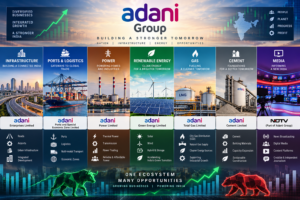
The current Adani investor page identifies these companies as listed companies:
| No. | Listed Company | Main Business / Sector | Common Market Identifier |
|---|---|---|---|
| 1 | Adani Enterprises Ltd | Infrastructure, new businesses, airports, roads, new energy and other businesses | AEL |
| 2 | Adani Ports & Special Economic Zone Ltd | Ports and logistics | APSEZ |
| 3 | Adani Power Ltd | Power generation | APL |
| 4 | Adani Energy Solutions Ltd | Power transmission and distribution | AESL |
| 5 | Adani Green Energy Ltd | Renewable energy | AGEL |
| 6 | Adani Total Gas Ltd | City gas distribution and energy transition businesses | ATGL |
| 7 | Ambuja Cements Ltd | Cement and building materials | AMBUJACEM |
| 8 | ACC Ltd | Cement and building materials | ACC |
| 9 | NDTV Ltd | Media and news broadcasting | NDTV |
Note: Stock prices are deliberately not included as static figures in this evergreen article because market prices change continuously. Readers should check the latest NSE/BSE/company information before making decisions.
Key Takeaways
- The Adani Group has businesses across several infrastructure and utility sectors.
- The current Adani investor page lists nine listed companies.
- Adani Enterprises acts as the group’s flagship listed incubator company and has businesses including airports, roads, new energy, data centres and other emerging areas.
- APSEZ focuses on ports and logistics.
- Adani Power is primarily associated with power generation.
- Adani Energy Solutions operates in electricity transmission and distribution.
- Adani Green Energy focuses on renewable energy.
- Adani Total Gas operates city gas distribution and has expanded into newer energy businesses.
- Ambuja Cements and ACC form the core of the group’s cement platform.
- NDTV is part of the listed portfolio on Adani’s investor page.
- Sanghi Industries and Orient Cement are associated with the Adani cement portfolio through Ambuja Cements, but should be distinguished from the nine companies currently presented as listed companies on the main Adani investor page.
1. Adani Enterprises Ltd
Adani Enterprises Ltd (AEL) is the flagship incubator company of the Adani Group.
Unlike a company focused on only one mature business, AEL has historically been used to develop and incubate new businesses before they mature and potentially become separate platforms.
Its current business portfolio includes areas such as:
- Airports
- Roads
- New energy
- Solar manufacturing
- Wind turbine manufacturing
- Data centres
- Natural resources
- Agri-related businesses
- Defence and aerospace
- Water
- Petrochemicals
- Other emerging infrastructure businesses
The company’s FY2025-26 integrated annual report reported total income of ₹1,02,943 crore, EBITDA of ₹16,464 crore and PAT attributable to shareholders of ₹9,339 crore. These are historical reported figures for FY2025-26 and should not be treated as current-period results.
AEL’s annual report also describes its airports, roads, new-energy and data-centre businesses. It reported eight operational airports, 13 operational road projects and more than 55 MW of operational data-centre capacity in the FY2025-26 report.
Why investors track Adani Enterprises
Investors may follow AEL because it provides exposure to several emerging infrastructure and new-business areas through a single listed company.
However, the diversified nature of the business also means that investors need to understand different business segments rather than judging the company using a single metric.
What to check
- Segment-wise revenue
- EBITDA contribution
- Debt and leverage
- Cash generation
- New-business capital expenditure
- Airport performance
- Roads portfolio
- New-energy manufacturing
- Data-centre development
- Valuation
2. Adani Ports & Special Economic Zone Ltd
Adani Ports & Special Economic Zone Ltd (APSEZ) is the group’s ports and logistics company.
Its business extends beyond simply operating individual ports. The company operates across port infrastructure and logistics-related activities.
APSEZ is therefore different from Adani Power or Adani Green Energy because its performance is closely linked to:
- Cargo volumes
- Port capacity
- Logistics activity
- Trade flows
- Infrastructure utilisation
- Domestic and international port operations
The Adani Group reported in October 2026 that APSEZ’s Colombo West International Terminal had doubled its capacity to 3.2 million TEUs following investment of approximately US$750 million.
What investors should examine
When researching APSEZ, look beyond the share price.
Useful indicators include:
- Cargo volumes
- Container volumes
- Revenue growth
- EBITDA
- Port capacity
- Logistics performance
- Debt
- Capital expenditure
- International expansion
- Cash flow
3. Adani Power Ltd
Adani Power Ltd is the group’s major power-generation company.
Power generation is influenced by several factors, including:
- Electricity demand
- Plant availability
- Power tariffs
- Fuel costs
- Coal availability
- Merchant power prices
- Regulation
- Capacity utilisation
This means investors should not judge a power-generation company simply by looking at quarterly profit.
Important factors to research
Before analysing Adani Power, consider:
- Installed generation capacity
- Capacity utilisation
- Power generation
- Revenue
- EBITDA
- Profit
- Fuel availability
- Coal costs
- Debt
- Capital expenditure
- Long-term power agreements
- Merchant-power exposure
The Adani Group’s current investor information continues to list Adani Power among its listed companies.
4. Adani Green Energy Ltd
Adani Green Energy Ltd (AGEL) is the group’s renewable-energy company.
Its focus includes large-scale renewable-energy projects, particularly solar and wind generation.
Renewable-energy companies need to be evaluated differently from conventional power companies.
Important factors include:
- Renewable generation capacity
- Capacity utilisation
- Project commissioning
- Power purchase agreements
- Debt
- Financing costs
- Cash flows
- Project pipeline
- Solar and wind resource conditions
- Regulatory developments
The Adani Group reported in October 2026 that Adani Green Energy had expanded battery-storage capacity to 6.63 GWh, representing more than half of India’s operational battery-energy-storage-system capacity according to the group’s announcement.
That development is particularly relevant for investors studying the company’s transition from renewable generation toward broader energy-storage capabilities.
5. Adani Energy Solutions Ltd
Adani Energy Solutions Ltd (AESL) operates in electricity transmission and distribution infrastructure.
This business should not be confused with Adani Power.
A simple distinction is:
| Company | Primary Area |
|---|---|
| Adani Power | Power generation |
| Adani Energy Solutions | Power transmission and distribution |
| Adani Green Energy | Renewable power generation |
For AESL, investors should examine:
- Transmission network
- Distribution operations
- Regulated returns
- Network expansion
- Revenue
- EBITDA
- Debt
- Capital expenditure
- Regulatory environment
- Distribution performance
The Adani Group’s current listed-company information identifies Adani Energy Solutions as one of its listed companies.
6. Adani Total Gas Ltd
Adani Total Gas Ltd (ATGL) operates primarily in city gas distribution and has expanded into newer energy-related businesses.
The company reported operations across CNG and PNG as well as newer activities such as e-mobility and biomass.
In its FY2025-26 results announcement, ATGL reported that its CNG network had expanded to 705 stations, PNG household connections had reached approximately 1.1 million and EV charging points had increased to about 5,100.
For Q1 FY2026-27, the company reported standalone revenue from operations of ₹1,910 crore, EBITDA of ₹281 crore and PAT of ₹133 crore.
These figures are historical reported results and should always be checked against the latest quarterly filing when publishing a current article.
What investors should monitor
- CNG volume
- PNG connections
- Gas sourcing
- Gas prices
- EBITDA
- PAT
- Geographical areas
- EV charging expansion
- New-energy businesses
- Debt
- Regulatory changes
7. Ambuja Cements Ltd
Ambuja Cements Ltd is a major cement and building-materials company within the Adani portfolio.
The cement business has expanded significantly through acquisitions and integration.
Ambuja’s annual-report information says its acquisitions included businesses such as Orient Cement, Penna Cement Industries, Sanghi Industries and other cement assets.
This makes Ambuja particularly important when studying the Adani Group’s cement strategy.
What affects a cement stock?
Investors should consider:
- Cement volumes
- Realisation per tonne
- EBITDA per tonne
- Capacity utilisation
- Coal and petcoke costs
- Freight costs
- Capacity additions
- Regional demand
- Infrastructure and housing demand
- Debt
- Free cash flow
8. ACC Ltd
ACC Ltd is another major cement company associated with the Adani cement platform.
ACC’s annual-report material describes its integration with the Adani portfolio and the broader cement expansion involving Ambuja Cements.
For investors, ACC should be analysed on its own financial and operational performance even though it is part of the broader Adani cement ecosystem.
Important metrics
- Cement sales
- Clinker production
- Capacity utilisation
- EBITDA per tonne
- Cost per tonne
- Energy cost
- Freight cost
- Profit
- Debt
- Cash flow
9. NDTV Ltd
NDTV Ltd is the media company in the current Adani listed-company portfolio.
The Adani Group’s portfolio presentation reported promoter holding of 69.02% in NDTV after completion of its rights issue in October 2025.
Media businesses have a different economic model from infrastructure and energy companies.
When analysing NDTV, investors should therefore look at:
- Advertising revenue
- Digital traffic
- Subscription-related revenue where applicable
- Television operations
- Digital media
- Operating expenses
- Profitability
- Cash flow
- Audience trends
- Competitive environment
What About Sanghi Industries and Orient Cement?
This is an important point because many online “Adani Group stocks lists” can become outdated.
Sanghi Industries and Orient Cement are part of the Adani cement ecosystem through Ambuja Cements.
The Adani Group’s portfolio information states that Ambuja Cements held 58.08% of Sanghi Industries and 72.66% of Orient Cement in the referenced portfolio structure.
However, readers should distinguish:
Directly listed companies shown on the current Adani investor page
from
companies held through another Adani-controlled listed company.
That distinction makes an Adani Group stock list much more accurate.
There is also a major corporate-development angle here: Ambuja Cements’ board approved schemes in December 2025 for the proposed amalgamation of ACC and Orient Cement, subject to the required approvals.
Therefore, readers should verify the latest corporate status before publishing any article that describes Orient Cement as a separate standalone Adani stock.
Is AWL Agri Business an Adani Group Stock?
This is another area where older articles can mislead readers.
The company formerly known as Adani Wilmar Ltd changed its name to AWL Agri Business Ltd in March 2025. Its own official website describes it as AWL Agri Business Limited, formerly Adani Wilmar Limited.
The current Adani investor page does not include AWL among the nine listed companies shown there.
Therefore, an updated 2026 article should not simply copy an old list that calls Adani Wilmar one of the current Adani Group stocks.
This is exactly why stock-list articles need periodic research and updating.
Adani Group Stocks by Sector
A useful way to understand the portfolio is to divide the companies by business.
| Sector | Company |
|---|---|
| Infrastructure / Incubation | Adani Enterprises |
| Ports & Logistics | Adani Ports & SEZ |
| Power Generation | Adani Power |
| Renewable Energy | Adani Green Energy |
| Transmission & Distribution | Adani Energy Solutions |
| City Gas / Energy Transition | Adani Total Gas |
| Cement | Ambuja Cements |
| Cement | ACC |
| Media | NDTV |
This sector-based view is more useful than simply memorising company names.
How to Check Adani Share Prices
Adani share prices change during market hours.
Therefore, a website should avoid publishing an old price as if it were live.
For the latest price, investors can check the relevant security on:
- NSE
- BSE
- The company’s investor-relations website
- Reputable market-data platforms
When creating a FinBankingTech article, use a dated price if a historical price is discussed.
Adani All Share List With Price: Why a Static Table Is Not Ideal
The keyword “Adani all share list with price” has clear search intent, but a static article table containing today’s prices creates a maintenance problem.
A better FinBankingTech structure would be:
| Company | Sector | Latest Price | Last Updated | Result |
|---|---|---|---|---|
| Adani Enterprises | Infrastructure | Live/updated data | Date/time | View analysis |
| Adani Ports | Ports & Logistics | Live/updated data | Date/time | View analysis |
| Adani Power | Power | Live/updated data | Date/time | View analysis |
| Adani Green Energy | Renewable Energy | Live/updated data | Date/time | View analysis |
| Adani Energy Solutions | Transmission & Distribution | Live/updated data | Date/time | View analysis |
| Adani Total Gas | City Gas | Live/updated data | Date/time | View analysis |
| Ambuja Cements | Cement | Live/updated data | Date/time | View analysis |
| ACC | Cement | Live/updated data | Date/time | View analysis |
| NDTV | Media | Live/updated data | Date/time | View analysis |
Editorial recommendation: populate the price column through a properly maintained market-data source rather than manually inserting a number into the article.
How to Research an Adani Stock Before Investing
A stock’s low share price does not automatically mean it is cheap.
For example, a ₹100 stock can be more expensive relative to its fundamentals than a ₹1,000 stock.
A basic research framework should include:
1. Understand the business
Ask:
- What does the company sell?
- Who are its customers?
- How does it generate revenue?
- What are its major business segments?
2. Examine revenue
Look at:
- Revenue growth
- Segment contribution
- Quarterly trend
- Year-on-year growth
3. Examine profit
Check:
- Operating profit
- EBITDA
- PAT
- EPS
- Margin trends
4. Examine debt
Debt is particularly important for capital-intensive infrastructure businesses.
Look at:
- Total debt
- Net debt
- Debt-to-equity
- Interest expense
- Cash flow
5. Examine valuation
Depending on the company, investors may examine:
- P/E
- P/B
- EV/EBITDA
- EV/Revenue
- Dividend yield
No single ratio is sufficient for every Adani company because the businesses operate in very different sectors.
6. Study cash flow
Profit and cash generation are not identical.
A company can report accounting profit while cash flow is affected by:
- Working capital
- Capital expenditure
- Receivables
- Inventory
- Financing activities
7. Read official filings
For serious research, review:
- Annual reports
- Quarterly results
- Investor presentations
- Exchange filings
- Corporate announcements
Adani Stocks Are Not One Investment
One of the biggest mistakes a beginner can make is treating all Adani stocks as if they were the same investment.
Consider the difference:
Adani Ports → ports and logistics
Adani Power → conventional power generation
Adani Green Energy → renewable energy
Adani Energy Solutions → transmission and distribution
Adani Total Gas → city gas distribution and newer energy businesses
Ambuja Cements → cement
NDTV → media
Their:
- revenue models,
- costs,
- capital requirements,
- debt structures,
- growth drivers,
- regulations,
- valuations
can be very different.
Therefore, an investor should research the individual company, not merely the group name.
Adani Group Stocks: Advantages and Risks
Potential Advantages
Depending on the individual company, the Adani portfolio provides exposure to areas such as:
- Infrastructure
- Logistics
- Energy
- Renewable energy
- Electricity transmission
- Gas distribution
- Cement
- Media
- New-energy technologies
The group’s official portfolio information describes its strategy as centred on infrastructure and utility businesses, alongside newer areas such as new energy and data centres.
Risks and Limitations
Adani-related stocks can also carry significant company-specific and sector-specific risks.
Investors should consider:
- High capital requirements
- Debt and financing costs
- Regulatory risk
- Commodity-price risk
- Interest-rate sensitivity
- Project-execution risk
- Valuation risk
- Sector cyclicality
- Corporate-governance considerations
- Market volatility
- Concentration risk
The appropriate risk assessment differs from company to company.
Illustrative Example
Suppose an investor has ₹20,000 and wants exposure to an Adani-related company.
A common mistake would be:
“The share price has fallen, so it must be cheap.”
A better approach would be to ask:
- Why did the price fall?
- Has the company’s earnings outlook changed?
- Is debt increasing?
- Is cash flow improving?
- Is the current valuation reasonable?
- What are the major sector risks?
- What could make the investment thesis wrong?
This does not guarantee a better investment outcome, but it creates a more disciplined research process.
Common Mistakes to Avoid
1. Choosing a stock only because its price is low
A low nominal share price does not mean a stock is undervalued.
2. Treating every Adani company as identical
The businesses are substantially different.
3. Looking only at one quarter
Quarterly results should generally be viewed in context.
4. Ignoring debt
Debt can materially affect capital-intensive companies.
5. Following social-media stock tips
A viral post is not a substitute for financial research.
6. Assuming past returns will continue
Historical performance does not guarantee future performance.
7. Using an outdated company list
Corporate structures, names and holdings can change.
8. Publishing old share prices as current
A stock price needs a date and, where appropriate, a time reference.
9. Looking at P/E alone
Different sectors require different valuation approaches.
10. Confusing group association with direct ownership
A company may be associated with the broader portfolio through another listed company.
Adani Group Stocks PDF
FinBankingTech can create an original educational PDF around this topic rather than offering an unofficial or copyrighted market report.
Suggested PDF Title
Adani Group Stocks List in India — Companies, Sectors & Investor Research Guide
Suggested PDF Contents
- Adani Group listed-company list
- Company names
- Business sectors
- Stock-market identifiers
- Business overview
- Key financial metrics to monitor
- Fundamental-analysis checklist
- Risk checklist
- Dividend and corporate-action checklist
- Official-source directory
- Stock-market terminology
- Educational disclaimer
Suggested file name:
adani-group-stocks-list-india-guide.pdf
The PDF should be clearly identified as a FinBankingTech Original Educational Resource, not an official Adani Group document.
Important Official Sources
| Resource | Purpose |
|---|---|
| Adani Group Investors | Listed companies, investor information and corporate updates |
| NSE | Exchange information and filings |
| BSE | Exchange information and filings |
| Individual company investor pages | Annual reports, results and company disclosures |
| SEBI | Securities-market regulatory information |
The Adani investor page is particularly useful for checking the current group-level list of listed companies.
Frequently Asked Questions
1. How many Adani Group stocks are listed in India?
The current Adani investor page lists nine listed companies: Adani Enterprises, Adani Ports & SEZ, Adani Power, Adani Energy Solutions, Adani Green Energy, Adani Total Gas, ACC, Ambuja Cements and NDTV.
2. Which is the main Adani Group company?
Adani Enterprises is the flagship incubator company of the Adani Group. It develops and operates businesses across several infrastructure and emerging sectors.
3. What are the Adani Group power stocks?
Adani Power is primarily the group’s power-generation company, while Adani Energy Solutions operates in transmission and distribution and Adani Green Energy focuses on renewable power generation.
4. Is Adani Green Energy a renewable-energy stock?
Yes. Adani Green Energy is the group’s renewable-energy company, with operations focused on large-scale renewable energy.
5. Is Adani Energy Solutions the same as Adani Power?
No. Adani Power is primarily involved in power generation, while Adani Energy Solutions operates in transmission and distribution.
6. What does Adani Total Gas do?
Adani Total Gas operates in city gas distribution and has also expanded into businesses including e-mobility and biomass.
7. Is Ambuja Cements an Adani Group company?
Ambuja Cements is part of the Adani Group’s cement platform. The Adani portfolio information reports a controlling stake in Ambuja Cements.
8. Is ACC an Adani Group stock?
ACC is included among the listed companies on the current Adani investor page and forms part of the group’s cement portfolio.
9. Is NDTV an Adani Group company?
NDTV is included among the listed companies on the Adani investor page.
10. Is Adani Wilmar still called Adani Wilmar?
No. The company changed its name to AWL Agri Business Limited in March 2025. Its official website continues to identify it as AWL Agri Business, formerly Adani Wilmar.
11. Are Sanghi Industries and Orient Cement Adani stocks?
They are part of the broader Adani cement portfolio through Ambuja Cements. The Adani portfolio information reports Ambuja’s stakes in both companies. Their treatment should therefore be distinguished from the nine companies listed directly on the current Adani investor page.
12. Where can I check the latest Adani share price?
The latest market price should be checked through NSE, BSE or another reliable live market-data service. A price quoted in an article should always include its relevant date or timestamp.
13. Which Adani stock is best for long-term investment?
There is no universally “best” Adani stock for every investor. Each company has different fundamentals, valuation, business risks and growth drivers. Investors should research their financial objectives and risk tolerance before making a decision.
14. Should beginners invest in Adani stocks?
Beginners should first understand how equities work, including volatility, valuation, diversification and financial risk. A beginner should not purchase a stock solely because it is associated with a famous business group.
15. Are Adani stocks safe?
No equity investment can be described as risk-free. Individual Adani stocks are exposed to market, business, regulatory, financing and sector-specific risks.
16. Can Adani share prices fall?
Yes. Like other listed equities, Adani stocks can rise or fall depending on company results, valuations, market conditions, sector developments, investor sentiment and other factors.
17. Where can I find Adani company financial results?
The relevant company’s investor-relations section and stock-exchange filings are appropriate sources for official financial results.
18. Should I buy an Adani stock because its share price has fallen?
Not necessarily. A price decline may reflect a change in valuation, business expectations, market conditions or company-specific developments. Investors should investigate the reason for the decline rather than assuming the stock has become cheap.
19. What should I check before investing in an Adani company?
At minimum, examine the business model, revenue, profit, debt, cash flow, valuation, industry conditions, corporate announcements and major risks.
20. Is this article investment advice?
No. This article is an educational overview of Adani Group companies and stock-market research concepts. It is not personalised investment advice or a recommendation to buy or sell a security.
Final Takeaway
The Adani Group stocks list in India is broader than a simple list of companies carrying the Adani name.
The current Adani investor page lists nine listed companies: Adani Enterprises, Adani Ports & SEZ, Adani Power, Adani Energy Solutions, Adani Green Energy, Adani Total Gas, Ambuja Cements, ACC and NDTV.
The portfolio spans very different industries, so investors should avoid treating the group as one single investment category.
For someone researching these companies, the more useful approach is to study each stock individually:
Business → Revenue → Profit → Debt → Cash Flow → Valuation → Growth → Risks → Latest filings.
The list should also be updated periodically because corporate structures, subsidiaries, mergers, names and holdings can change. The Adani cement portfolio, for example, has undergone substantial consolidation and acquisition activity, including the proposed amalgamation of ACC and Orient Cement with Ambuja Cements subject to required approvals.
For the latest information, readers should always verify company disclosures and stock-exchange information before making an investment decision.
Disclaimer
Disclaimer: This article is intended for educational and informational purposes only. Stock-market investments are subject to market risks, and past performance does not guarantee future returns. The information provided should not be considered personalised investment advice or a recommendation to buy or sell any security. Company information, share prices, financial results, corporate structures and regulatory developments can change. Readers should verify the latest information from official company, NSE, BSE and regulatory sources and consider consulting a SEBI-registered investment professional where appropriate.
About FinBankingTech
FinBankingTech publishes educational and informational content covering the Indian stock market, shares, IPOs, banking, personal finance, mutual funds, insurance and investment awareness.
Official Website: https://finbankingtech.com
Telegram: https://t.me/FinbankingTech